

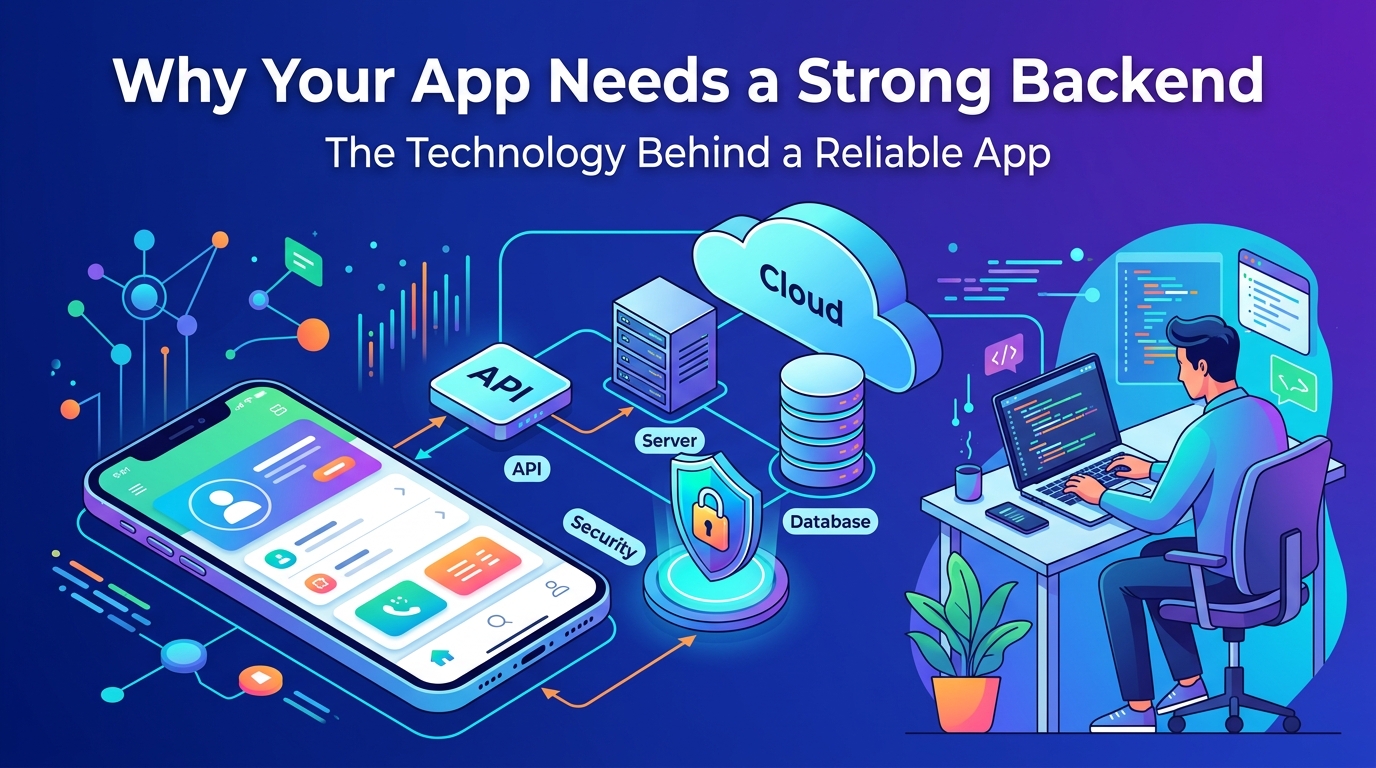
Why Your App Needs a Strong Backend
When people use a mobile application, they mostly see the frontend.
They see the buttons.
They see the screens.
They interact with forms, images, menus, and animations.
But behind almost every modern application is another important part that users rarely see:
The backend.
The backend is responsible for processing data, communicating with databases, handling authentication, managing business logic, connecting services, processing requests, and much more.
You can have an amazing UI and a great idea, but without a reliable backend, your application can quickly run into problems.
A strong backend is the foundation that allows a mobile application to operate reliably and grow over time.
What Is a Backend?
The backend is the server-side part of an application.
A simple way to understand it is:
Frontend = What users interact with
Backend = What happens behind the scenes
For example, imagine a shopping application.
A user opens the app and sees a product.
They tap:
Add to Cart
The mobile app sends a request to the backend.
The backend processes the request.
The database stores the cart information.
The backend sends a response back to the application.
The mobile app then updates the screen.
The user may only see a small change on the screen.
But several things can happen behind the scenes.
Why Is the Backend So Important?
A modern application often depends on the backend for almost every important operation.
The backend can manage:
- User accounts
- Authentication
- Databases
- APIs
- Business logic
- Payments
- Notifications
- Messaging
- File uploads
- Content
- Permissions
- Analytics
- Third-party integrations
This means the quality of your backend can directly affect the quality of your application.
1. Authentication and User Accounts
Most applications need some form of user authentication.
For example:
- Email and password
- Phone number
- OTP
- Social login
- Account verification
- Password recovery
The backend manages the authentication process and determines whether a user is allowed to access specific resources.
For example:
A normal customer should not automatically be able to access an administrator's data.
The backend should enforce these permissions.
2. APIs Connect Your App to Your Backend
Mobile applications commonly communicate with backend systems through APIs.
For example:
The mobile application requests:
Get user profile
The backend processes the request.
The database returns the relevant information.
The backend sends the response.
The mobile application displays the profile.
The same pattern can be used for:
- Products
- Orders
- Messages
- Jobs
- Bookings
- Notifications
- Payments
- User settings
APIs are essentially a communication layer between the application and backend services.
3. Database Management
Applications generate data.
A social application might store:
- User profiles
- Posts
- Comments
- Likes
- Followers
- Messages
An e-commerce application might store:
- Products
- Customers
- Orders
- Payments
- Inventory
A booking application might store:
- Services
- Customers
- Appointments
- Availability
- Booking history
The backend communicates with the database to create, read, update, and delete information.
A well-designed database structure is therefore an important part of application architecture.
4. Business Logic
The backend isn't simply a database connection.
It also contains business rules.
For example:
A customer places an order.
The backend may need to determine:
- Is the product available?
- Is the customer authenticated?
- Is the price correct?
- Is a discount applicable?
- Is payment successful?
- Should inventory be reduced?
- Should the order be created?
- Should the customer receive a notification?
These decisions are business logic.
Keeping important business rules on the server helps maintain consistent behavior across different clients.
5. Security
Security is one of the most important reasons to have a properly designed backend.
Applications may handle:
- Customer information
- Account credentials
- Payments
- Business data
- Private messages
- Documents
The backend should implement appropriate protections around authentication, authorization, data access, and communication.
For example, the mobile app should not be trusted to decide whether a user has administrator privileges.
The backend should verify permissions independently.
6. Payments
If your application processes payments, the backend becomes particularly important.
A payment workflow might look like:
Customer
↓
Mobile App
↓
Backend
↓
Payment Provider
↓
Backend
↓
Database
↓
Mobile App
The backend can coordinate the transaction and maintain the application's order or payment state.
Payment architecture should be designed carefully because failures can occur at different stages.
For example:
The payment succeeds, but the mobile application loses its internet connection before receiving the response.
The backend needs a reliable way to determine the actual transaction status.
7. Push Notifications
Backend systems can also manage push notifications.
For example:
A customer places an order.
↓
Backend creates the order.
↓
Order status changes.
↓
Backend triggers a notification.
↓
Customer receives:
Your order has been shipped.
This allows notifications to be connected to actual application events.
8. File and Media Management
Modern applications frequently handle files.
These could include:
- Profile pictures
- Product images
- Videos
- Documents
- Audio
- Attachments
A good backend architecture can manage file uploads and connect the application to appropriate storage systems.
For larger applications, media may be stored separately from the main database.
This can improve scalability and simplify media management.
9. Real-Time Features
Some applications require information to update immediately.
Examples include:
- Chat
- Live notifications
- Delivery tracking
- Live dashboards
- Real-time collaboration
- Live activity
These applications may use technologies designed for real-time communication.
The backend can coordinate events between users and clients.
For example:
User A sends a message.
↓
Backend receives the message.
↓
Message is stored.
↓
Backend sends an event to User B.
↓
User B sees the message immediately.
10. Performance
A backend can directly affect how fast an application feels.
Imagine a mobile screen that needs information from five different API calls before it can display useful content.
If those APIs are slow, the user experience will suffer.
Backend performance can involve:
- Efficient database queries
- Proper indexing
- Caching
- API optimization
- Efficient data processing
- Appropriate infrastructure
- Background jobs
The goal is to minimize unnecessary work and return useful responses efficiently.
11. Scalability
Your application may start with 100 users.
Then 1,000.
Then 10,000.
Then potentially much more.
The architecture that works perfectly for a small application may need to evolve as usage increases.
A scalable backend can be designed to handle increasing:
- Users
- Requests
- Database operations
- File storage
- Notifications
- Transactions
Scalability doesn't mean building the most complicated architecture from day one.
It means making sensible technical decisions that don't unnecessarily prevent future growth.
12. Reliability
Users expect applications to work.
If an API randomly fails, users may see:
Something went wrong.
If the backend repeatedly crashes, customers lose trust.
Reliable backend systems should consider:
- Error handling
- Logging
- Monitoring
- Database reliability
- Backups
- Recovery procedures
- Service availability
The exact approach depends on the application's requirements and expected scale.
13. Analytics
The backend can also play an important role in analytics.
For example, a business may want to understand:
- How many users registered?
- Which products are popular?
- How many orders were completed?
- Which features are used most?
- How many users return?
- Which campaigns generate conversions?
Analytics can help businesses make decisions based on actual application activity rather than assumptions.
14. Third-Party Integrations
Modern applications rarely work completely alone.
They may connect to external services for:
- Payments
- Maps
- SMS
- Push notifications
- Authentication
- Cloud storage
- Analytics
- AI services
The backend can act as an integration layer between the application and these external services.
This can also help protect sensitive credentials and centralize integration logic.
15. Admin Dashboards
Many applications need an administration system.
For example, a business may need to:
- Manage users
- Add products
- Review orders
- Manage services
- View reports
- Handle support requests
- Send notifications
- Manage content
The admin dashboard communicates with the same backend infrastructure.
This means the backend becomes the central system connecting the mobile application and business operations.
What Happens When the Backend Is Weak?
A weak backend can create serious problems.
Slow App
Poor database queries or inefficient APIs can cause slow screens.
Crashes
Unhandled backend failures can break important workflows.
Security Problems
Poor authentication or authorization can expose data.
Data Inconsistency
Poor transaction handling can create incorrect records.
Scaling Problems
An architecture designed without growth in mind can struggle when traffic increases.
Difficult Maintenance
Poorly organized backend code can make every future change more expensive.
Poor User Experience
Ultimately, backend problems become user-facing problems.
A Simple Example
Imagine you're building a food delivery application.
The customer sees:
Restaurant List
Menu
Cart
Checkout
Order Tracking
But behind the scenes, the backend is managing:
User Authentication
↓
Restaurant Data
↓
Menu Data
↓
Cart
↓
Order Creation
↓
Payment
↓
Restaurant Notification
↓
Delivery Assignment
↓
Order Tracking
↓
Customer Notification
The customer sees a simple interface.
The backend is coordinating the entire workflow.
Backend Architecture Should Match the Product
There isn't one backend architecture that works for every application.
A small business application may only need a straightforward backend.
A large platform with millions of users may require more advanced infrastructure.
The appropriate architecture depends on:
- Number of users
- Expected traffic
- Data requirements
- Security requirements
- Business logic
- Real-time requirements
- Third-party services
- Budget
- Future growth
The important thing is to choose architecture based on the actual product.
Don't Over-Engineer Your First Version
There is another common mistake:
Building an extremely complicated backend before you have users.
A startup might spend months building complex infrastructure for a product that hasn't been validated.
A better approach is often:
Start with a solid foundation.
Build the essential features.
Launch.
Measure usage.
Improve the architecture as requirements grow.
Good engineering is not about making everything complicated.
It's about making the right technical decisions for the current and future needs of the product.
Mobile App + Backend = Complete Product
A mobile application shouldn't be thought of as just the screens.
A complete digital product often includes:
Mobile App
Backend
Database
APIs
Authentication
Cloud Infrastructure
Third-Party Integrations
Analytics
Together, these systems create the actual product.
What Makes a Strong Backend?
A strong backend should be:
Reliable
It should handle expected operations consistently.
Secure
It should protect users and business data appropriately.
Performant
It should process requests efficiently.
Scalable
It should have a reasonable path for handling growth.
Maintainable
Developers should be able to understand and modify the code.
Observable
Logging and monitoring should make problems easier to identify.
Flexible
The architecture should allow the product to evolve.
Final Thoughts
Your users may never see your backend.
They may never know which database you're using.
They may never care how your APIs are structured.
But they will notice the results.
They will notice when the app is fast.
They will notice when their data is safe.
They will notice when orders work correctly.
They will notice when notifications arrive on time.
They will notice when the application doesn't crash.
That's why backend development matters.
A beautiful frontend attracts users.
A strong backend helps keep the product reliable.
If you're building an application, don't think only about what users will see.
Think about the technology working behind every screen.
Build the frontend users love. Build the backend your business can depend on.
Frequently Asked Questions
What is a backend in mobile app development?
The backend is the server-side system responsible for processing requests, managing data, authentication, business logic, APIs, and other application operations.
Does every mobile app need a backend?
Not necessarily. Some simple applications can work primarily on-device. However, applications involving accounts, synchronization, online data, payments, messaging, or centralized business logic commonly need backend services.
Why are APIs important?
APIs allow the mobile application to communicate with backend systems and retrieve or modify information.
Can a backend improve app performance?
Yes. Efficient APIs, database queries, caching, and appropriate infrastructure can help improve application responsiveness.
Should I build a complex backend from the beginning?
Not always. The backend should be designed around the application's actual requirements and expected growth rather than unnecessary complexity.
What backend technology should a business use?
The best technology depends on the project. Factors include team expertise, application requirements, expected traffic, integrations, budget, and long-term maintenance.
Blog CTA
Building a mobile application?
Don't focus only on what users see.
The technology behind your app is just as important.
GoTech Studio helps businesses design and develop complete digital products with UI/UX design, Flutter and native mobile development, backend APIs, databases, integrations, authentication, analytics, and ongoing support.
Have an app idea? Let's build a strong foundation for it.