

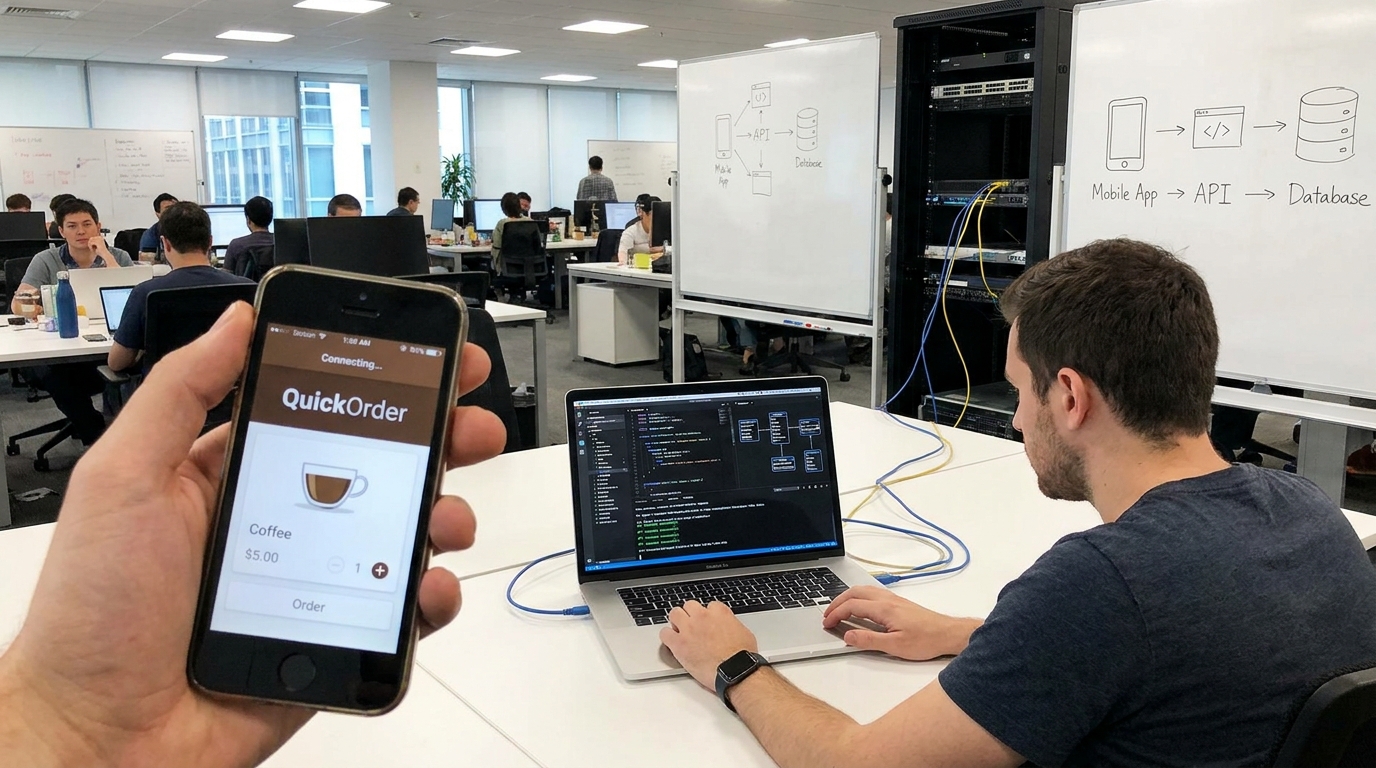
Why Backend Development Matters for Your Mobile App
When people think about building a mobile app, they usually focus on what they can see.
They think about the design, colors, buttons, animations, images, and different screens users will interact with.
Those things are important, but they are only one part of the application.
Behind many mobile apps, there is another system doing a lot of the work.
That's the backend.
The backend manages data, communicates with databases, processes requests, handles authentication, connects different services, and manages much of the business logic that makes an app actually work.
You might never see the backend when using an app, but you depend on it every time you log in, load your profile, place an order, send a message, or receive a notification.
So why does backend development matter so much?
Let's break it down.
What Is Backend Development?
In simple terms, backend development is about building the parts of an application that work behind the scenes.
Think about a food delivery app.
You open the app and see restaurants, menus, prices, and buttons.
That's the frontend.
But when you log in, the app needs to verify your account.
When you place an order, someone needs to process that order.
When you make a payment, the transaction needs to be handled.
When the restaurant accepts your order, your order status needs to change.
When the driver picks it up, you may receive a notification.
A large part of this happens through the backend.
The backend communicates with the database and other services to make these processes possible.
1. The Backend Manages Your Data
Almost every serious application works with data.
Depending on the type of application, this could include:
- User accounts
- Profiles
- Products
- Orders
- Messages
- Reviews
- Bookings
- Payments
- Notifications
- Settings
- Documents
- Application content
The backend communicates with the database to store and retrieve this information.
For example, when a user changes their profile name, the mobile app sends the request to the backend.
The backend validates the request and updates the appropriate information in the database.
The next time the user opens their profile, the updated information can be retrieved and displayed.
It sounds simple from the user's perspective.
But there is quite a lot happening behind that single action.
2. APIs Connect the Mobile App With the Backend
A mobile application needs a way to communicate with the backend.
This is where APIs come in.
An API allows the application to send requests and receive responses.
For example:
A user opens their profile.
The app sends a request to the backend.
The backend checks the user's authentication and retrieves the profile information from the database.
It then sends the required data back to the application.
The app displays the profile.
This same process can happen when users:
- Log in
- Register
- Search
- Create posts
- Upload information
- Place orders
- Send messages
- Update profiles
- Submit applications
A well-designed API makes communication between the mobile app and backend more organized and reliable.
3. Authentication Protects User Accounts
If your application has user accounts, authentication is an important part of backend development.
The system needs to know who the user is and what they are allowed to access.
For example, imagine an application with three types of users:
- Customer
- Business owner
- Administrator
A customer shouldn't automatically have access to administrator functions.
The backend can help enforce these rules.
Authentication and authorization may involve things such as secure login systems, tokens, password hashing, sessions, roles, and permissions.
The exact implementation depends on the application's requirements.
The important point is that access control should be handled properly rather than simply trusting information coming from the mobile application.
4. Business Logic Runs Behind the App
Every business has rules.
Your application needs to understand those rules.
Imagine an e-commerce application.
A customer adds a product to their cart and checks out.
The backend may need to:
- Check whether the product is available.
- Verify the price.
- Calculate the order total.
- Apply an eligible discount.
- Process the order.
- Update inventory.
- Save the transaction.
- Trigger a notification.
The customer might only see a confirmation screen.
But the backend is handling the actual business process.
This is why backend development needs to be planned around the business, not just around the screens of the application.
5. Payments Need Reliable Backend Processing
Applications that accept payments require additional care.
A payment isn't simply a button that says "Pay Now."
The system needs to communicate with the payment provider, track the transaction, verify the result, and update the relevant order or account.
The backend can be responsible for things such as:
- Creating payment requests
- Verifying transactions
- Recording payment status
- Updating orders
- Handling payment callbacks
- Managing refunds
- Maintaining transaction records
Important payment and business operations should be validated on the server rather than relying only on information sent by the mobile app.
6. Notifications Often Depend on the Backend
Notifications are another feature users experience without necessarily thinking about the backend behind them.
For example, an application might send a notification when:
- An order is shipped
- A booking is confirmed
- A new message arrives
- A payment is completed
- A new job is posted
- Someone responds to a request
- An important account update occurs
The backend can determine when a notification should be triggered and communicate with the appropriate notification service.
This allows businesses to keep users informed even when they aren't actively using the application.
7. User Roles and Permissions Become Easier to Manage
Many modern applications have multiple types of users.
A marketplace might have buyers and sellers.
A recruitment platform might have job seekers, employers, and administrators.
A service platform might have customers, service providers, and managers.
Each user type may need different access.
For example:
Customer: View products and place orders.
Seller: Manage products and orders.
Administrator: Manage users, products, reports, and settings.
The backend can enforce these permissions.
This becomes increasingly important as an application grows and the number of users and features increases.
8. A Good Backend Helps With Scalability
Maybe your app starts with a small number of users.
That's perfectly normal.
But what happens when your user base grows?
More users mean more requests, more database activity, more files, and potentially more simultaneous operations.
The backend needs to handle that growth efficiently.
Scalability can involve things such as:
- Efficient database queries
- Proper API architecture
- Caching
- Server optimization
- Monitoring
- Background processing
- Appropriate infrastructure
This doesn't mean every small app needs an extremely complicated architecture.
The goal is to build an architecture that matches the current requirements while leaving reasonable room for future growth.
9. Backend Performance Affects the User Experience
Users may not know what backend technology you're using.
They don't need to.
But they notice when something isn't working properly.
If an API takes too long to respond, users see a loading screen.
If a database query is slow, information takes longer to appear.
If the server goes down, important features may stop working.
So while backend development happens behind the scenes, it directly affects what users experience.
A smooth mobile interface needs reliable systems supporting it.
10. Security Is a Major Backend Responsibility
Security should be considered from the beginning of development.
A backend may handle sensitive user information, business data, account permissions, and transactions.
Depending on the application, security measures can include:
- Secure authentication
- Authorization
- Input validation
- API protection
- Password hashing
- Access controls
- Rate limiting
- Secure data handling
- Proper error handling
- Dependency updates
- Server security
No application can guarantee zero risk.
But a properly planned backend can reduce many avoidable security problems and provide better protection for application data.
11. Backend Connects External Services
Modern applications often depend on other services.
For example, an application might use:
- Payment gateways
- Cloud storage
- Email services
- SMS providers
- Maps
- Push notifications
- Analytics
- AI services
- Social login
- Third-party APIs
The backend can act as an important layer for managing these integrations.
This keeps external services organized and allows the application to process information before passing it between systems.
12. Admin Panels Need Backend Support
Businesses often need a way to manage their application.
That's where an admin panel becomes useful.
An admin might need to:
- Manage users
- Review reports
- Manage products
- Update content
- View orders
- Manage accounts
- Change settings
- Monitor activity
The admin panel communicates with the backend to perform these actions.
This means the backend isn't only supporting the mobile app.
It can become the central foundation connecting the mobile application, admin system, database, and external services.
Frontend and Backend Work Together
It's not really a question of frontend versus backend.
A successful application normally needs both.
The frontend creates the experience users interact with.
The backend provides much of the functionality and data behind that experience.
You can think of it like this:
| Frontend | Backend |
|---|---|
| Mobile screens | APIs |
| Buttons | Business logic |
| Forms | Database |
| Navigation | Authentication |
| Visual design | Permissions |
| User interactions | Server-side processing |
| App interface | External integrations |
Both sides need to work together properly.
What Technologies Can Be Used?
There are many options for backend development.
The right technology depends on the project rather than simply choosing whatever is currently popular.
For example, Node.js can be used to build APIs and server-side applications.
PHP is another widely used technology for backend and web development.
Different database technologies can also be selected depending on the application's data structure and requirements.
For a mobile application, the backend technology should be chosen based on factors such as:
- Project requirements
- Expected traffic
- Existing systems
- Integrations
- Development team
- Budget
- Long-term maintenance
- Scalability needs
There is no single backend technology that is perfect for every application.
Can a Beautiful App Still Fail Because of Its Backend?
Absolutely.
Imagine downloading an application that looks fantastic.
The design is modern.
The animations are smooth.
The interface looks professional.
But then you try to log in and the request keeps loading.
You open your profile and the data doesn't appear.
You try to place an order and receive an error.
You close and reopen the app, but the problem continues.
From the user's perspective, the application simply doesn't work.
They don't care whether the problem is an API, database query, server configuration, or authentication issue.
They just know the experience is frustrating.
That's why backend development deserves serious attention.
Build the Right Foundation From the Beginning
It's tempting to focus on the parts of an application that customers can see.
That's understandable.
But technical decisions made early in development can affect the product for years.
A properly planned backend can make it easier to:
- Add new features
- Manage growing data
- Maintain APIs
- Improve performance
- Manage users
- Integrate new services
- Troubleshoot problems
This doesn't mean over-engineering a simple application.
It means choosing a sensible architecture for the product you're actually building.
What If You Already Have an App?
If you already have a mobile application but are experiencing backend problems, you don't necessarily need to start from scratch.
An existing backend can be reviewed to identify problems with:
- API performance
- Database queries
- Authentication
- Server configuration
- Security
- Data structure
- Error handling
- Third-party integrations
- Scalability
Sometimes optimization and restructuring can solve problems without completely replacing the existing system.
The right approach depends on the current codebase and architecture.
Backend Development Is an Investment
A backend may not be visible to your customers, but it supports many of the things they depend on.
Every login, order, message, profile update, payment, notification, and database request can involve backend systems.
That's why backend development shouldn't be treated as something to add at the last minute.
It should be part of the product plan from the beginning.
How GoTech Studio Can Help
At GoTech Studio, we work on both the mobile application and the systems behind it.
Our development services include:
- Flutter app development
- Native Android development with Kotlin
- Node.js backend development
- PHP backend development
- REST API development
- Database integration
- Authentication and user roles
- Third-party API integration
- Backend optimization
- App maintenance and support
Whether you're starting a new app or your existing backend needs improvement, the first step is understanding what your product actually needs.
Final Thoughts
Your customers may never see your backend.
But they experience its results every time they use your application.
A strong backend helps your app manage data, process business logic, communicate with services, protect user accounts, and continue working as your business grows.
Good UI gets users interested. A reliable backend helps keep them there.
If you're planning a mobile application or need help improving the technology behind an existing one, talk to GoTech Studio and start building the right foundation for your product.