

Native vs Flutter: Which Should You Choose for Your Business?
Choosing the right technology is one of the most important decisions you'll make before building a mobile app. It affects your budget, development timeline, app performance, future updates, and long-term maintenance.
Two of the most popular approaches today are Native App Development and Flutter App Development. Both are powerful, but they serve different business needs.
Rather than asking which one is "better," the more useful question is: Which one is the better fit for your project?
In this guide, we'll compare both approaches to help you make an informed decision.
What Is Native App Development?
Native development means creating separate applications for each platform.
- Android apps are developed using Kotlin or Java.
- iOS apps are developed using Swift or Objective-C.
Each application is built specifically for its operating system, allowing developers to fully utilize platform-specific features and deliver maximum performance.
What Is Flutter?
Flutter is Google's cross-platform framework that allows developers to build Android and iOS apps from a single codebase using the Dart programming language.
Instead of maintaining two separate projects, developers write the code once and deploy it to multiple platforms.
This approach reduces development time while maintaining a modern and consistent user interface.
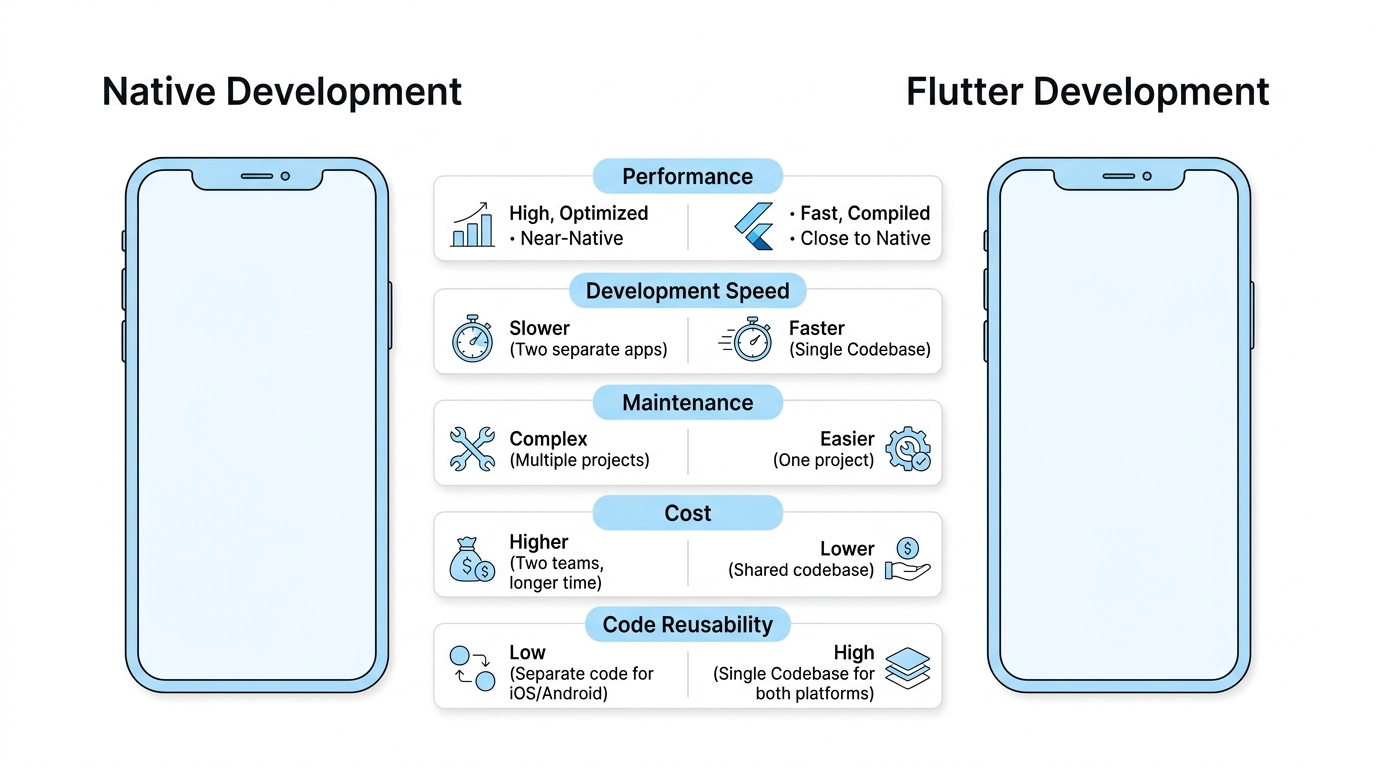
Native vs Flutter Comparison
| Feature | Native | Flutter |
|---|---|---|
| Codebase | Separate for Android & iOS | One codebase |
| Development Speed | Moderate | Fast |
| Cost | Higher | More affordable |
| Performance | Excellent | Excellent for most apps |
| UI Consistency | Platform-specific | Consistent across platforms |
| Maintenance | Two projects | One project |
| Time to Market | Longer | Faster |
Performance
Native apps have direct access to operating system APIs and hardware, making them the preferred choice for applications that demand the highest levels of performance.
Examples include:
- High-end mobile games
- Video editing applications
- AR and VR experiences
- Complex financial applications
- Advanced camera processing
Flutter also delivers excellent performance for the vast majority of business applications, including:
- E-commerce apps
- Booking platforms
- Social media apps
- Delivery services
- Healthcare apps
- Educational platforms
- Business management tools
For most companies, users are unlikely to notice a significant performance difference.
Development Time
If speed is a priority, Flutter has a clear advantage.
With one shared codebase, developers can build features once and deploy them across Android and iOS simultaneously.
Native development requires separate implementations for each platform, which generally increases development time.
For startups looking to validate ideas quickly, Flutter can significantly shorten the journey from concept to launch.
Cost
Budget is an important consideration for every business.
Native development often requires:
- Separate Android development
- Separate iOS development
- Independent testing
- Individual maintenance for each platform
Flutter simplifies much of this work through a shared codebase, making it a cost-effective choice for many startups and small businesses.
Maintenance
Every application requires updates.
With Native development, updates typically need to be implemented separately for Android and iOS.
Flutter allows many updates to be made once, reducing maintenance effort and helping teams release improvements more efficiently.
User Experience
Native applications naturally follow the design guidelines of their respective platforms.
Flutter provides a consistent user interface across Android and iOS while also supporting platform-specific customization when needed.
Both approaches can deliver excellent user experiences when designed thoughtfully.
When Should You Choose Native?
Native development is a strong choice if your app:
- Requires maximum performance.
- Depends heavily on platform-specific APIs.
- Includes advanced graphics or gaming.
- Uses complex hardware integrations.
- Needs deep operating system optimization.
When Should You Choose Flutter?
Flutter is ideal if you want to:
- Launch on Android and iOS quickly.
- Reduce development costs.
- Maintain one shared codebase.
- Build an MVP.
- Scale your application efficiently.
- Maintain consistent branding across platforms.
Many startups choose Flutter because it balances speed, quality, and affordability.
Common Misconceptions
"Flutter is only for small apps."
Not true. Flutter powers many production applications used by businesses around the world, from startups to large enterprises.
"Native is always faster."
Native offers the highest level of platform optimization, but Flutter provides excellent performance for most business applications. The right choice depends on your project's requirements rather than assumptions.
"Cross-platform apps look identical on every device."
Flutter allows developers to create consistent interfaces while still adapting to platform-specific behaviors and design patterns where appropriate.
How to Make the Right Choice
Before deciding, ask yourself:
- Who are your users?
- What platforms do they use?
- How quickly do you want to launch?
- What is your budget?
- Will your app require advanced hardware features?
- How often will you release updates?
- What are your long-term growth plans?
The answers to these questions will guide you toward the most suitable technology.
Final Thoughts
Both Native and Flutter are excellent technologies for building mobile applications.
Native development is ideal for projects that require the highest level of platform-specific performance and integration.
Flutter is an excellent choice for businesses seeking faster development, lower maintenance, and a consistent experience across Android and iOS.
The most important decision isn't choosing the most popular technology—it's choosing the one that best supports your business goals.
Frequently Asked Questions
Is Flutter good for business apps?
Yes. Flutter is well-suited for e-commerce, education, healthcare, logistics, social networking, and many other business applications.
Is Native development faster than Flutter?
Native apps can achieve the highest platform-specific performance, but Flutter offers excellent performance for most business use cases while reducing development time.
Which option is more affordable?
Flutter is generally more cost-effective because a single codebase can be used for both Android and iOS, reducing development and maintenance effort.
Can I switch from Flutter to Native later?
Yes. Many businesses begin with Flutter to validate their idea and later choose Native for specific performance or platform requirements if their product evolves.
Blog CTA
Choosing the right technology is one of the most important decisions in any app development project. A well-informed choice can save time, reduce costs, simplify maintenance, and support long-term growth.
At GoTech Studio, we specialize in both Native Android (Kotlin & Jetpack Compose) and Flutter development. We evaluate your business goals, technical requirements, and budget to recommend the solution that delivers the best results.
Have an app idea? Get in touch with GoTech Studio and let's build the right solution from day one.