

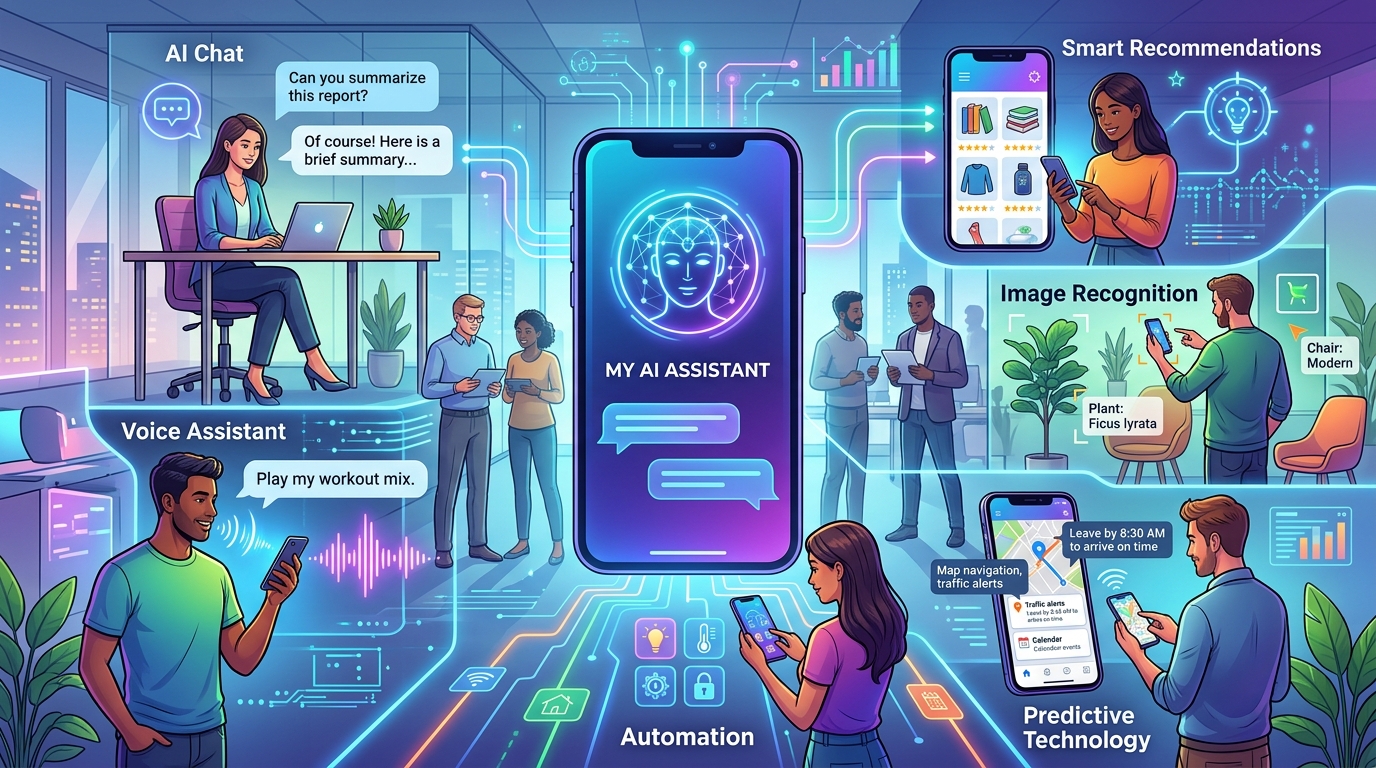
How AI Is Changing Mobile Apps: The Future of Intelligent App Experiences
Mobile applications have evolved significantly over the last decade.
Early apps were primarily designed to perform specific tasks.
Today, users increasingly expect applications to understand their needs, personalize their experiences, respond naturally, and automate repetitive work.
Artificial intelligence is helping make this possible.
AI is transforming mobile applications from simple tools into more intelligent digital experiences.
For businesses, this creates new opportunities to improve customer service, increase productivity, personalize products, and create completely new features.
The important question isn't whether an app should use AI.
The better question is:
Where can AI create real value for the user?
What Does AI Mean for Mobile Apps?
AI allows applications to analyze information, recognize patterns, understand language, generate content, make predictions, and respond to users in more intelligent ways.
Instead of an app simply following predefined instructions, AI can help it adapt to different situations.
For example, a traditional search system may look for exact keywords.
An AI-powered search system can better understand the user's intent.
Instead of asking:
"Show me red shoes."
A user could ask:
"I need comfortable running shoes for beginners."
An intelligent system can interpret the request and provide more relevant results.
1. AI-Powered Personalization
One of the biggest opportunities for AI in mobile apps is personalization.
Different users have different interests and behaviors.
AI can analyze user activity and provide more relevant experiences.
For example:
An e-commerce app can recommend products.
A streaming app can recommend movies.
A learning app can suggest courses.
A news app can personalize articles.
A job platform can recommend relevant opportunities.
Instead of showing everyone the same content, AI can help create experiences that are more relevant to individual users.
2. AI Chat Assistants
AI assistants are becoming an increasingly useful feature inside mobile applications.
Instead of searching through menus or help pages, users can ask questions using natural language.
For example:
User: "Where is my order?"
The AI assistant can retrieve relevant information and provide an answer.
Or:
User: "Find jobs for a Flutter developer with three years of experience."
The system can understand the request and provide relevant results.
AI assistants can make complicated applications easier to navigate.
3. Smarter Search
Search is another area where AI can dramatically improve the user experience.
Traditional search often depends heavily on keywords.
AI-powered search can understand:
- Context
- Intent
- Natural language
- Spelling variations
- Related concepts
This means users can search using normal language instead of trying to guess the exact keywords required by the system.
Better search can be especially valuable for large marketplaces, job platforms, e-commerce applications, and content-based products.
4. Voice Interaction
AI is also changing how people interact with applications through voice.
Instead of typing everything manually, users can speak naturally.
Voice AI can be used for:
- Searching
- Creating reminders
- Writing messages
- Customer support
- Navigation
- Accessibility
- Content creation
Voice interaction can make applications faster and easier to use, particularly in situations where typing isn't convenient.
5. Image and Document Analysis
Modern AI models can analyze images and documents in ways that were previously difficult to implement.
For example, an application could allow users to:
- Scan documents
- Extract text
- Identify objects
- Analyze images
- Categorize products
- Read receipts
- Process forms
This can reduce manual work and create entirely new workflows.
A business application could allow employees to photograph a document and automatically extract the required information.
6. AI for Automation
Many businesses spend significant time on repetitive tasks.
AI can help automate parts of these workflows.
For example:
- Summarizing documents
- Categorizing customer requests
- Drafting responses
- Organizing information
- Processing support tickets
- Generating reports
- Extracting data
Automation doesn't necessarily mean replacing people.
Often, the goal is to remove repetitive work so employees can focus on more valuable tasks.
7. Predictive Features
AI can also help applications predict what might happen next.
For example, an application could analyze historical behavior to estimate:
- Which products a customer may want.
- Which users may stop engaging.
- When demand may increase.
- Which content a user may prefer.
- Which customers may need support.
Predictive features can help businesses become more proactive rather than simply reacting to events.
8. AI-Powered Customer Support
Customer support can be expensive and time-consuming.
AI can help businesses handle common questions automatically.
A mobile application could provide an AI assistant that answers questions about:
- Products
- Orders
- Account settings
- Services
- Policies
- General troubleshooting
More complicated requests can still be transferred to human support agents.
This creates a combination of automation and human assistance.
9. Better Recommendations
Recommendation systems are one of the most established uses of AI.
AI can analyze behavior and identify patterns to suggest relevant content or products.
For example:
A customer purchases a laptop.
The application could recommend:
- Laptop accessories
- A suitable mouse
- A keyboard
- A laptop bag
The recommendations become more useful when the system understands the customer's interests and previous activity.
10. AI Can Improve Developer Productivity
AI isn't only changing the features inside mobile applications.
It's also changing how applications are built.
Developers can use AI-assisted tools to help with:
- Code generation
- Debugging
- Documentation
- Testing
- Refactoring
- Code explanations
- Development research
However, AI-generated code still needs proper engineering review, testing, security checks, and human judgment.
AI can accelerate development, but it doesn't remove the need for experienced developers.
AI Doesn't Mean Every App Needs a Chatbot
One common mistake businesses make is assuming that adding a chatbot automatically makes their application an AI-powered product.
That's not necessarily true.
AI should solve a meaningful problem.
For one business, an AI assistant may be valuable.
For another, recommendation systems may create more value.
For another, document processing or predictive analytics may be the better opportunity.
The technology should follow the business problem—not the other way around.
Challenges of Adding AI to Mobile Apps
AI provides significant opportunities, but businesses should also consider its challenges.
Cost
Some AI services charge based on usage. As the number of users increases, AI-related infrastructure and API costs can also increase.
Privacy
Businesses need to carefully consider what user data is sent to AI systems and how that data is handled.
Accuracy
AI systems can sometimes produce incorrect or unexpected results.
Important business decisions should have appropriate validation and safeguards.
Performance
Some AI features can require significant processing power or network communication.
Developers need to design the experience carefully to keep applications responsive.
Security
AI features introduce additional considerations around authentication, data access, prompts, APIs, and sensitive information.
How Businesses Should Approach AI
Before adding AI to your application, ask:
What problem are we solving?
Then consider:
- Who benefits from the AI feature?
- What data is required?
- How accurate does the system need to be?
- What will it cost at scale?
- How will user privacy be protected?
- What happens when AI gives an incorrect answer?
- Should the AI run on the device or in the cloud?
These questions help businesses avoid adding AI simply because it is currently popular.
The Future of Mobile Apps
AI will likely become increasingly integrated into everyday mobile experiences.
Instead of users manually navigating through complicated interfaces, applications may increasingly understand what users want and help them accomplish tasks with fewer steps.
Imagine an app where a user can simply say:
"Find me the best option under my budget and order it for delivery tomorrow."
The application could understand the request, search available options, compare them, and guide the user through the process.
This represents a shift from traditional apps that require users to operate every feature manually toward applications that can assist users more intelligently.
Final Thoughts
Artificial intelligence is changing mobile app development, but the biggest opportunity isn't simply adding the latest AI technology.
It's using AI to create a better product.
Personalization, intelligent search, voice interaction, automation, document analysis, recommendations, and AI assistants can all provide meaningful value when implemented correctly.
Businesses that focus on real user problems will be better positioned to use AI effectively.
The future of mobile apps isn't just about having more features.
It's about creating applications that are more intelligent, useful, personalized, and easier to use.
Frequently Asked Questions
Can AI be added to an existing mobile app?
Yes. AI can be integrated into existing applications through APIs, cloud services, machine learning models, or other AI technologies depending on the use case.
Does every mobile app need AI?
No. AI should only be added when it solves a meaningful problem or improves the user experience.
Can AI reduce app development time?
AI-assisted development tools can help developers with coding, testing, debugging, documentation, and other tasks, but experienced developers are still needed to review and validate the work.
Is AI expensive to add to an app?
Costs vary depending on the AI technology, number of users, model, infrastructure, and frequency of usage. AI costs should be considered during architecture planning.
Is AI secure for mobile applications?
AI can be used securely, but businesses need appropriate authentication, authorization, data protection, privacy controls, and validation.
Blog CTA
AI is creating new possibilities for mobile applications, but successful AI features start with a clear business problem—not simply the desire to use new technology.
At GoTech Studio, we help businesses explore practical ways to integrate AI into mobile applications, from intelligent assistants and recommendations to automation, smart search, and document processing.
Have an app idea that could benefit from AI? Contact GoTech Studio and let's turn the idea into a practical, scalable product.