AI Agents vs Traditional Chatbots: What Is the Difference?
Businesses have been using chatbots for a long time.
You have probably seen them on websites, online stores, and messaging platforms. A customer asks a question, and the chatbot provides an answer.
For simple questions, this works well.
But businesses today need more than just automated answers.
They need systems that can understand what a customer wants, take the next step, work with business data, and help complete actual tasks.
This is where AI agents come in.
What Is a Traditional Chatbot?
A traditional chatbot is mainly designed to communicate with users.
For example, a website chatbot might answer questions such as:
- What are your business hours?
- Where are you located?
- What services do you offer?
- How can I contact you?
- What is your pricing?
Many traditional chatbots work with predefined flows or a limited set of responses.
They can be useful, especially when a business receives the same questions repeatedly.
But there is a limitation.
If the customer asks something outside the chatbot's expected flow, the conversation may stop or the customer may be asked to contact a human.
What Is an AI Agent?
An AI agent is designed to do more than have a conversation.
It can understand a user's request, decide what information is needed, interact with connected tools or systems, and help move a task forward.
For example, imagine someone visits a software company's website and says:
"I need an app for my business. I want Android and iPhone versions, and I need an admin panel."
A basic chatbot might simply respond with information about app development.
An AI agent could take the conversation further.
It could ask:
- What type of business do you have?
- What features do you need?
- Do you already have a design?
- Do you need a backend?
- When do you want to launch?
It could then organize the requirements and pass the qualified lead to the sales team.
That's a very different experience.
Chatbot vs AI Agent
The easiest way to understand the difference is this:
A traditional chatbot mainly answers.
An AI agent can understand, decide, and act.
A chatbot might tell a customer how to book an appointment.
An AI agent could potentially collect the customer's preferred date and time, check an available scheduling system, and help complete the booking process.
The exact capabilities depend on the systems and permissions connected to the agent, but the key difference is that agents can be designed around completing workflows rather than only responding to questions.
AI Agents Can Help With Lead Qualification
Lead generation is one area where AI agents can be especially useful.
Many businesses receive inquiries from people who are interested but are not ready to buy.
A team member then has to ask questions, understand the requirement, collect contact information, and decide whether the lead is worth following up with.
An AI agent can handle much of this initial conversation.
It can ask relevant questions, understand the responses, collect required information, and send the lead to the appropriate team.
Your sales team can then spend more time talking to qualified prospects instead of answering the same basic questions all day.
AI Agents Can Work With Business Systems
This is another major difference.
A chatbot may live inside a website or messaging platform and provide information.
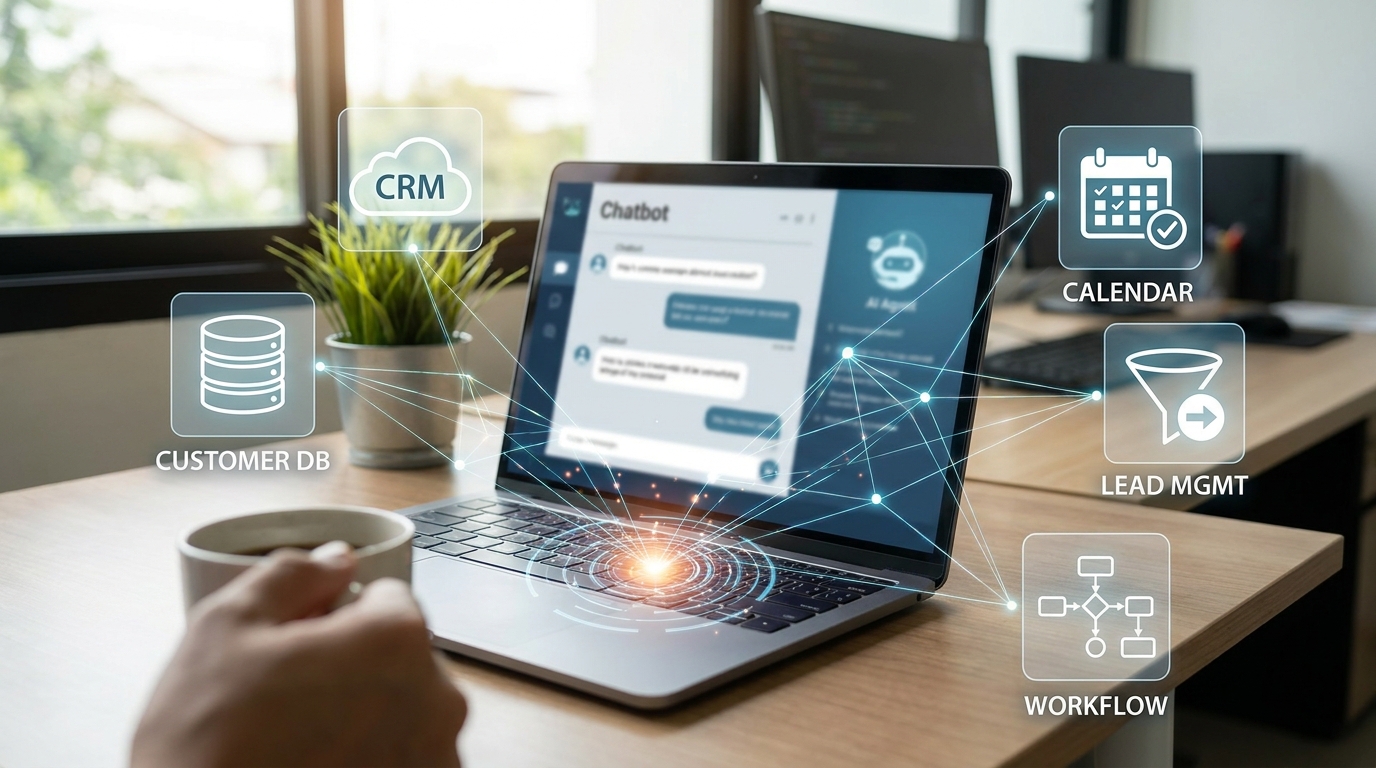
An AI agent can be connected to systems such as:
- CRM platforms
- Databases
- Calendars
- Customer support systems
- Internal business tools
- APIs
- Inventory systems
- Lead management systems
This allows the AI to become part of the business workflow.
For example, an e-commerce business could use an AI assistant to help customers find products and provide information based on available product data.
A service business could use an AI agent to collect project requirements and send them to its CRM.
A consulting business could use one to collect information before a team member joins the conversation.
AI Agents and Customer Support
Customer support is another common use case.
Customers often ask the same questions repeatedly.
Instead of making employees answer every basic question manually, an AI agent can handle common requests and guide customers through the next step.
It can help with things like:
- Product information
- Service questions
- Order-related queries
- Basic troubleshooting
- Frequently asked questions
- Requirement collection
- Support requests
When the situation requires human attention, the conversation can be transferred to a team member.
The goal isn't necessarily to replace humans.
The goal is to reduce repetitive work so humans can focus on problems that actually need them.
AI Agents Can Work on Websites and WhatsApp
Businesses don't have to limit AI agents to one platform.
Depending on the requirements, an AI solution can be connected to a website, WhatsApp, mobile application, or internal business system.
This can be particularly useful for businesses that already receive many inquiries through messaging.
Instead of customers waiting for someone from the team to reply, an AI assistant can respond immediately and start collecting the information needed to help them.
Does Every Business Need an AI Agent?
Not necessarily.
Sometimes a simple chatbot is enough.
If your business only needs to answer a few common questions, a traditional chatbot can be a practical solution.
But if your business has repetitive workflows, receives many inquiries, needs lead qualification, or relies on several different systems, an AI agent may provide much more value.
The important thing is not to use AI simply because it is popular.
The technology should solve a real business problem.
Start With the Problem, Not the AI
One mistake businesses make is starting with:
"Where can we add AI?"
A better question is:
"What task is taking too much time?"
Maybe your team spends hours answering the same customer questions.
Maybe leads are coming through WhatsApp but nobody has time to qualify them properly.
Maybe employees manually enter information into different systems.
Maybe customers need help outside business hours.
These are better starting points.
Once the problem is clear, you can decide whether a chatbot, AI assistant, or full AI agent makes sense.
The Future Is More Than Automated Conversations
AI is changing the way businesses think about automation.
The next step isn't simply having a chatbot that can talk.
It's having AI that can become part of your actual business processes.
That could mean answering a customer, collecting requirements, qualifying a lead, updating a system, sending information to a team member, or helping move a workflow forward.
The best AI solutions will be the ones that solve real problems without making the customer experience complicated.
How GoTech Studio Can Help
At GoTech Studio, we build custom AI solutions based on how a business actually works.
This can include:
- Custom AI Agents
- AI Chatbots
- Website AI Assistants
- WhatsApp AI Integration
- Lead Qualification
- Business Workflow Automation
- API and System Integrations
Instead of forcing every business into the same chatbot, the goal is to build an AI solution around your specific requirements.
Final Thoughts
Traditional chatbots are still useful.
They can answer common questions and provide a simple automated customer experience.
But AI agents can go much further.
They can understand more complex requests, work with business systems, support workflows, qualify leads, and help businesses automate tasks that previously required manual work.
The right choice depends on what your business actually needs.
If you only need answers, a chatbot may be enough.
If you want AI to help your business do things, an AI agent may be the better direction.