

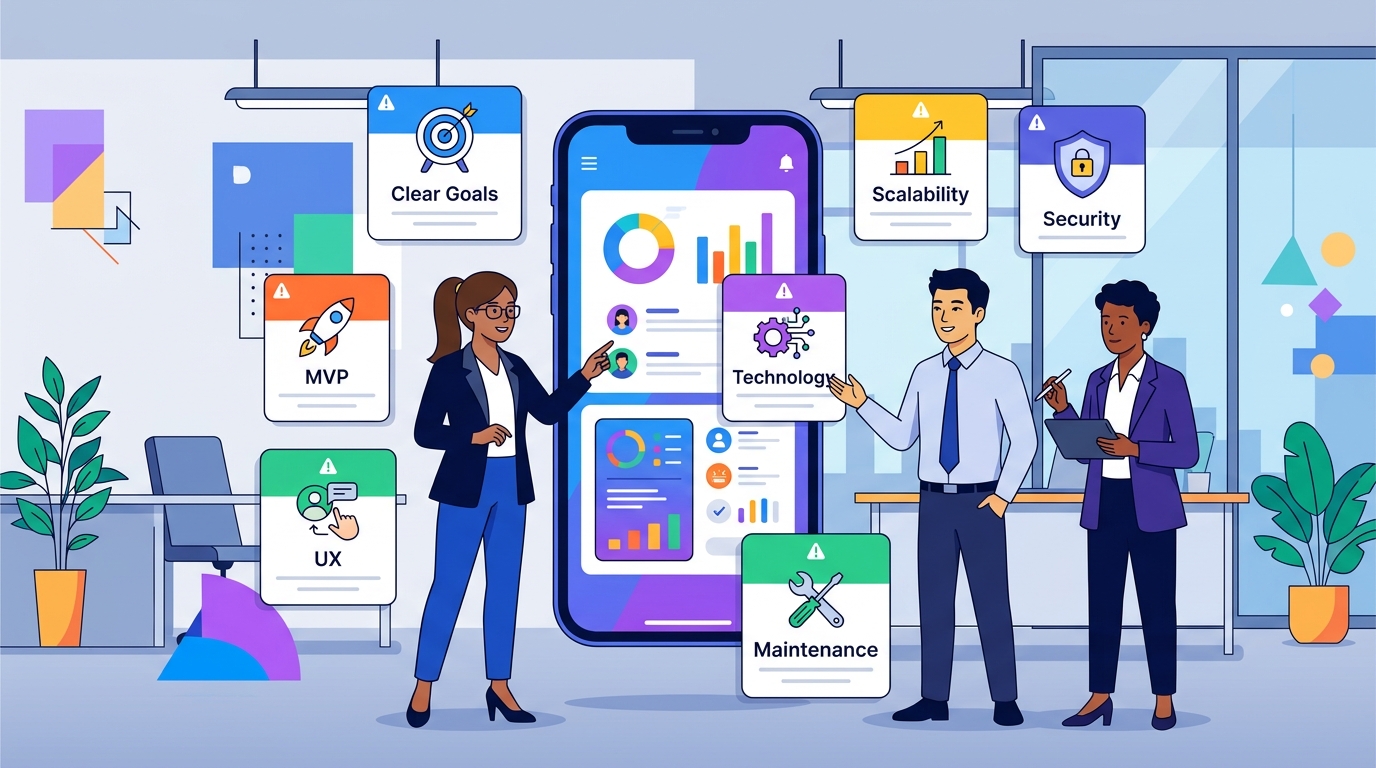
7 Common Mistakes Businesses Make When Building a Mobile App
A mobile application can become a powerful tool for attracting customers, increasing revenue, improving operations, and creating new business opportunities.
But building a successful app involves much more than writing code.
Many businesses start development with an exciting idea but don't spend enough time planning the product, understanding users, selecting the right technology, or thinking about long-term maintenance.
These mistakes can lead to higher development costs, delays, poor user experiences, and even failed products.
Here are seven common mistakes businesses should avoid.
1. Starting Development Without Clear Goals
One of the biggest mistakes is starting development before clearly defining what the application is supposed to achieve.
A business might say:
"We need an app."
But that's not enough.
You should first understand:
- What problem does the app solve?
- Who are the target users?
- What makes the app valuable?
- What action do you want users to take?
- How will the business measure success?
For example, an e-commerce application may focus on increasing purchases, while a job platform may focus on successful applications.
The product goals should influence the design and development decisions from the beginning.
2. Trying to Build Too Many Features
Businesses often want to include every possible feature in the first version.
Chat.
Payments.
Live streaming.
Social feeds.
Advanced analytics.
AI.
Subscriptions.
Notifications.
And much more.
The problem is that too many features can increase development time and cost while making the application complicated for users.
A better approach is to create a focused Minimum Viable Product (MVP).
Start with the core functionality needed to solve the primary problem.
After launch, user feedback and analytics can help determine which features should be added next.
3. Ignoring User Experience
An application can have excellent technology and still fail if users don't understand how to use it.
Good UX should make important actions simple and intuitive.
Before development, businesses should consider:
- Navigation.
- Onboarding.
- Screen structure.
- Button placement.
- Forms.
- Error messages.
- Loading states.
- Accessibility.
Users shouldn't have to figure out how your app works through trial and error.
The best interfaces often feel simple because considerable thought went into making them simple.
4. Choosing Technology Without Considering the Product
Technology choices can have a major impact on development speed, cost, performance, and maintenance.
Some projects may benefit from native development, while others may be better suited to cross-platform technologies such as Flutter.
The correct decision depends on factors such as:
- Required performance.
- Target platforms.
- Budget.
- Development timeline.
- Hardware integrations.
- Future scalability.
- Available development resources.
Technology should support the business strategy rather than being selected simply because it is popular.
5. Ignoring Scalability
Your app may start with a few hundred users.
But what happens when it reaches 10,000, 100,000, or even millions?
If scalability isn't considered early, rapid growth can create:
- Slow response times.
- Database bottlenecks.
- Server overload.
- Increased downtime.
- Poor user experience.
A scalable architecture doesn't necessarily mean building an unnecessarily complicated system from day one.
Instead, it means making thoughtful architectural decisions that allow the product to grow.
6. Treating Security as an Afterthought
Security should be part of development from the beginning.
Mobile applications often handle sensitive information such as:
- User accounts.
- Personal information.
- Payments.
- Messages.
- Business data.
Security considerations should include:
- Secure authentication.
- Proper authorization.
- Protected APIs.
- Safe data storage.
- Secure network communication.
- Dependency management.
- Regular security updates.
Trying to add security after the application is already built can be much more difficult than considering it from the beginning.
7. Forgetting About Maintenance
Launching an application is not the end of development.
Mobile operating systems change.
Libraries are updated.
Security threats evolve.
Users request new features.
Devices change.
Your application needs to evolve with them.
Ongoing maintenance may include:
- Bug fixes.
- Performance optimization.
- Security updates.
- OS compatibility.
- Backend improvements.
- UI updates.
- New features.
Businesses that plan for maintenance from the beginning are better prepared for long-term growth.
How to Avoid These Mistakes
A successful development process usually starts before writing the first line of code.
Begin with:
Product Planning
Define the problem, target audience, business model, and goals.
UX/UI Design
Create user flows and interfaces before development begins.
Technology Planning
Choose technologies based on actual requirements.
MVP Development
Focus on the features that provide the most value.
Testing
Test functionality, performance, security, and usability before launch.
Analytics
Track important user actions after launch.
Continuous Improvement
Use feedback and data to improve the product over time.
Why Planning Saves Money
It can be tempting to start coding immediately.
But changes made during development can be significantly more expensive than decisions made during the planning stage.
For example, changing a feature during wireframing may take minutes.
Changing the same feature after backend APIs, database structures, and mobile screens have already been developed can require much more work.
Good planning isn't slowing down development.
It helps prevent unnecessary development.
Final Thoughts
A successful mobile application is the result of many decisions—not just good programming.
Clear goals, focused features, strong UX, appropriate technology, scalability, security, and ongoing maintenance all contribute to a stronger product.
Avoiding common mistakes before development begins can save your business significant time and money while creating a better experience for your users.
The goal shouldn't simply be to launch an app.
The goal should be to build an app that people actually want to use.
Frequently Asked Questions
What is the biggest mistake when building an app?
One of the biggest mistakes is starting development without clearly defining the problem, target users, and goals of the application.
Should I build every feature in the first version?
Usually, no. Starting with a focused MVP allows you to validate the idea, collect feedback, and prioritize future features based on real user needs.
Is UX really important for a mobile app?
Yes. Users interact directly with the interface, so confusing navigation or complicated workflows can negatively affect engagement even when the underlying technology is excellent.
When should security be considered?
Security should be considered from the beginning of the development process rather than added as an afterthought.
Does an app need maintenance after launch?
Yes. Regular maintenance helps keep the application secure, compatible, stable, and aligned with changing user expectations.
Blog CTA
Building a mobile app is a major investment. Avoiding the right mistakes from the beginning can save time, reduce unnecessary costs, and give your product a much stronger foundation.
At GoTech Studio, we help businesses move from idea to reliable mobile application with proper product planning, UI/UX design, development, testing, deployment, and ongoing maintenance.
Have an app idea? Contact GoTech Studio and let's plan your product the right way from day one.