

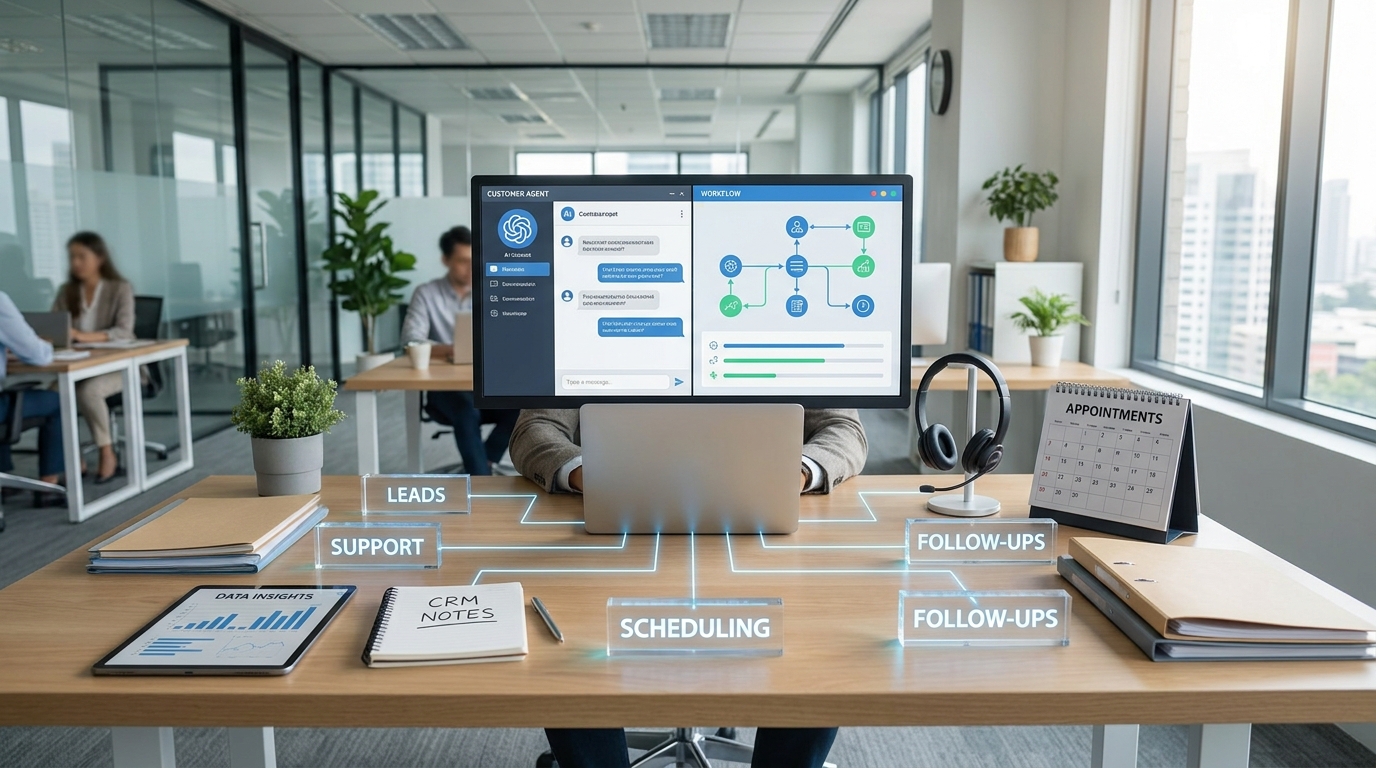
AI has become a popular topic for businesses, but there is still a lot of confusion around what an AI agent can actually do.
Some people think an AI agent is simply another name for a chatbot.
It isn't.
A basic chatbot might answer a customer's question.
A custom AI agent can be designed to understand the request, decide what needs to happen next, use connected business information, and help move the task forward.
That's what makes custom AI agents interesting for businesses.
Instead of using the same AI experience for everyone, you can build an agent around your own products, services, customers, and workflows.
1. Answer Customer Questions
One of the simplest uses of an AI agent is customer communication.
Customers often ask the same questions again and again.
For example:
- What services do you offer?
- How much does a service cost?
- How long does a project take?
- What are your business hours?
- Do you deliver to my area?
- How can I place an order?
- What information do you need from me?
An AI agent can handle many of these conversations automatically.
This means your team doesn't have to stop what they're doing every time someone asks a basic question.
And because the agent can be available around the clock, customers don't necessarily have to wait for business hours to get an initial response.
2. Qualify New Leads
Getting leads is one thing.
Knowing which leads are actually serious is another.
Imagine someone contacts your company and says:
"I need a mobile app for my business."
Instead of immediately sending the conversation to a salesperson, an AI agent can ask a few useful questions.
It might ask what type of business they have, what features they need, which platforms they want, and when they want to launch.
The answers can then be organized and passed to the sales team.
Now the salesperson isn't starting with a blank conversation.
They already have useful information about the potential client.
3. Collect Customer Requirements
Requirement gathering can take a surprising amount of time.
A customer may send information across several messages, emails, or calls.
A custom AI agent can make this process more organized.
For example, a software development company could have an AI agent ask about:
- Business type
- Required platform
- Main features
- User types
- Integrations
- Budget range
- Expected launch date
The agent can then organize the responses into a structured format.
Your team can review the information and continue from there.
This doesn't remove the need for human involvement. It simply makes the first stage much easier.
4. Provide Customer Support
Customer support is another area where AI agents can save time.
Businesses often have support teams spending hours answering similar questions.
A custom AI agent can handle common requests before involving a human.
It could help customers understand a product, find relevant information, troubleshoot simple problems, or collect details about an issue.
If the request becomes complicated, the agent can hand it over to a human team member.
This creates a useful balance.
AI handles repetitive conversations.
People handle the situations that require judgment, experience, or personal attention.
5. Recommend Products or Services
A custom AI agent can also help customers decide what they need.
For example, an online store might have dozens or hundreds of products.
Instead of making customers search through every product page, an AI assistant can ask what they're looking for and guide them toward suitable options.
The same idea works for service businesses.
A customer might not know whether they need a particular service.
The AI can ask questions about their situation and explain which service may be relevant.
This can make the buying process much easier.
6. Schedule Appointments
Businesses that depend on appointments can use AI agents to simplify scheduling.
For example, a customer could start a conversation and explain that they want to book a consultation.
The AI agent can collect the necessary details and, when connected to an appropriate scheduling system, help find or arrange an available time.
This can reduce the back-and-forth messages that normally happen during appointment booking.
Instead of:
"Are you free Monday?"
"No."
"What about Tuesday?"
"Maybe."
The process can become much more structured.
7. Connect With Your CRM
The real value of an AI agent often appears when it is connected to the rest of the business.
A CRM can contain important information about leads and customers.
With the right integration, an AI agent can help move information between the conversation and the CRM.
For example, after a lead provides their details, the relevant information could be sent to the company's lead management system.
The sales team can then continue the conversation without manually copying everything from a chat.
8. Work With APIs and Business Systems
Custom AI agents don't have to operate in isolation.
They can be connected to APIs and other software systems.
Depending on the business requirements, an agent might interact with systems for:
- Customer management
- Orders
- Inventory
- Scheduling
- Payments
- Notifications
- Internal tools
- Databases
This is where AI automation becomes much more useful.
The AI isn't simply talking about the business.
It can become part of the business workflow.
9. Automate Follow-Ups
Following up with leads is important, but it is also easy to forget.
A potential customer might ask for information today and then disappear.
A properly designed AI workflow can help manage follow-ups according to the business process.
For example, after an inquiry, the system could send an appropriate follow-up message later.
The exact timing and behavior would depend on the business requirements.
The important idea is simple:
Don't let good leads disappear just because someone forgot to follow up.
10. Work Through WhatsApp
For many businesses, customers already prefer messaging.
That makes WhatsApp a natural place for AI-powered customer communication.
A custom AI agent can be designed to handle conversations, answer questions, collect requirements, qualify leads, and guide customers through the next step.
Instead of asking customers to learn a completely new system, businesses can bring automation into a channel they already use.
11. Provide 24/7 First-Level Assistance
Your business may close at 6 PM.
Your customers don't stop having questions at 6 PM.
An AI agent can provide an initial response outside normal working hours.
It can explain services, answer common questions, collect contact details, and gather requirements so your team can follow up later.
This doesn't mean every customer interaction needs to be completely automated.
Sometimes the best experience is simply giving the customer a useful first response and making sure their request reaches the right person.
12. Give Your Team an Internal AI Assistant
AI agents aren't only for customers.
Businesses can also create internal assistants for employees.
For example, an internal AI assistant could help employees find information from company documents, understand internal processes, or retrieve frequently needed information.
This can be especially useful when employees constantly ask the same questions or spend time searching through different systems.
The Important Part: Customization
This is why the word custom matters.
Every business has different processes.
A restaurant doesn't operate like a software company.
An online store doesn't operate like a consulting business.
A recruitment company has completely different workflows from a healthcare business.
So there isn't one AI agent that is perfect for everyone.
The agent should be designed around the actual problem you want to solve.
AI Should Solve a Real Business Problem
Adding AI just because everyone is talking about it isn't necessarily a good strategy.
Start with the problem.
Ask:
What task is taking too much time?
What questions are we answering repeatedly?
Where are leads getting lost?
What information are employees entering manually?
Which customer process has too many steps?
These questions can reveal where an AI agent could provide real value.
AI Agents Don't Have to Replace Your Team
One of the biggest misunderstandings about AI automation is that businesses have to choose between AI and people.
That's not always the case.
A good AI workflow can work alongside your team.
The AI can handle repetitive first-level tasks while employees focus on more important work.
For example:
AI: Collects customer requirements.
Team: Reviews the requirements and prepares the solution.
AI: Answers common questions.
Team: Handles complex cases.
AI: Qualifies leads.
Sales team: Talks to serious prospects.
This approach can make teams more efficient without removing the human side of the business.
Build AI Around Your Workflow
The best AI agent isn't necessarily the one with the most features.
It's the one that solves the right problem.
A small AI agent that successfully automates one important workflow can be more valuable than a complicated system that nobody knows how to use.
Start small.
Choose one repetitive process.
Automate it.
Measure the results.
Then expand when it makes sense.
How GoTech Studio Can Help
At GoTech Studio, we build custom AI solutions based on real business requirements.
Our AI development services can include:
- Custom AI Agents
- AI Chatbots
- Website AI Assistants
- WhatsApp AI Integration
- Lead Qualification
- Customer Support Automation
- Business Workflow Automation
- API and Backend Integrations
The goal isn't simply to put an AI chatbot on your website.
The goal is to create something that actually helps your business work better.
Final Thoughts
A custom AI agent can be much more than a question-and-answer tool.
It can communicate with customers, collect information, qualify leads, support employees, automate follow-ups, connect with business systems, and help manage repetitive workflows.
But the technology itself isn't the main point.
The real value comes from solving a genuine business problem.
If your team is spending too much time on repetitive tasks, that might be a good place to explore AI automation.
Have a business workflow you want to automate? GoTech Studio can help turn the idea into a practical AI solution.