

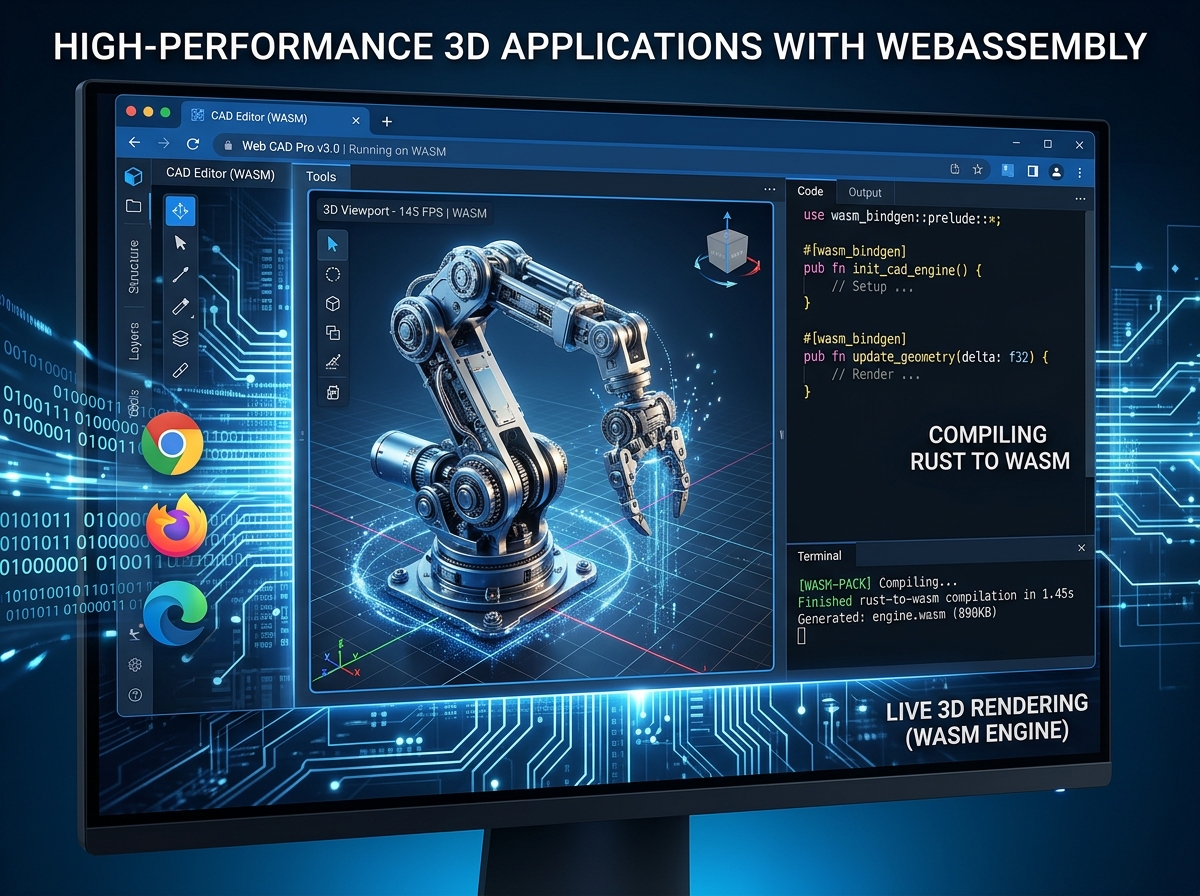
WebAssembly has crossed the chasm from experimental technology to production standard. In 2026, WASM powers applications that seemed impossible in browsers just years ago. Understanding this technology is now essential for web developers.
What Is WebAssembly?
WebAssembly is a binary instruction format that runs at near-native speed in browsers. It's not a programming language you write directly—instead, you compile languages like C++, Rust, Go, and now Python to WASM. The result runs in a sandboxed environment alongside JavaScript.
Why 2026 Is Different
Browser support reached 95% global coverage. The WebAssembly System Interface (WASI) enables WASM to run outside browsers—in servers, edge functions, and IoT devices. Component Model standardization allows WASM modules to communicate across languages.
Real-World Applications
Video and Photo Editing
Adobe Photoshop now runs in browsers via WASM, offering 90% of desktop functionality. DaVinci Resolve's web version uses WASM for real-time video editing. These aren't stripped-down versions—they're full professional tools.
CAD and 3D Modeling
AutoCAD Web runs complex engineering drawings in browsers. Three.js with WASM backends handles million-polygon models smoothly. Architects and engineers collaborate on designs without installing heavy software.
Gaming
Unity and Unreal Engine export to WASM, enabling console-quality games in browsers. Google Stadia's technology stack relied heavily on WASM for game streaming clients. Indie developers publish complex games without platform gatekeepers.
Scientific Computing
JupyterLite runs Python entirely in browsers via WASM, eliminating server dependencies. Bioinformatics tools analyze DNA sequences client-side. Financial models run Monte Carlo simulations in browsers without sending sensitive data to servers.
Machine Learning
TensorFlow.js with WASM backends runs ML inference 10x faster than pure JavaScript. On-device face recognition, natural language processing, and recommendation engines work without cloud round-trips.
Development Workflow Compilation:
Rust and C++ compile to WASM via Emscripten or wasm-pack. Python compiles via Pyodide. Go has native WASM support.
Debugging:
Browser DevTools now support WASM source maps, allowing you to debug original source code rather than binary.
Performance:
WASM modules start instantly with streaming compilation. Memory management requires attention—WASM uses linear memory that must be explicitly managed.
Integration with JavaScript
WASM doesn't replace JavaScript—it complements it. JS handles DOM manipulation, network requests, and user interactions. WASM handles compute-intensive tasks. They communicate via shared memory and function calls.
Security Model
WASM runs in the same sandbox as JavaScript, with additional constraints. It can't access the DOM directly or make system calls. WASI provides controlled access to files, networks, and clocks when running outside browsers.
Challenges Bundle Size:
WASM modules can be large. Compression and lazy loading are essential. Tree-shaking removes unused code.
Debugging Complexity:
While improving, debugging across language boundaries remains harder than pure JavaScript development.
Ecosystem Maturity:
Not all libraries have WASM versions. Polyfills and bridges are sometimes necessary.
The Future
WebAssembly Component Model will enable plug-and-play modules across languages. WASI preview 2 promises portable serverless functions. WebGPU integration will unlock GPU compute from WASM, enabling browser-based AI training.
Conclusion
WebAssembly has matured from promise to production reality. For developers, it means the web platform can now handle virtually any computational task. The boundary between web and native applications continues to blur.